Overview

The Ross Sea, Antarctica

is stunning. A jigsaw puzzle of floating ice extends to the horizon in all directions, punctuated by floating mountains of blue ice that saw at the sky like jagged teeth. It is a desert of ice, subjected to 6 months of solid night, 200 kph winds, and temperatures of -40°C. It is also filled with life.

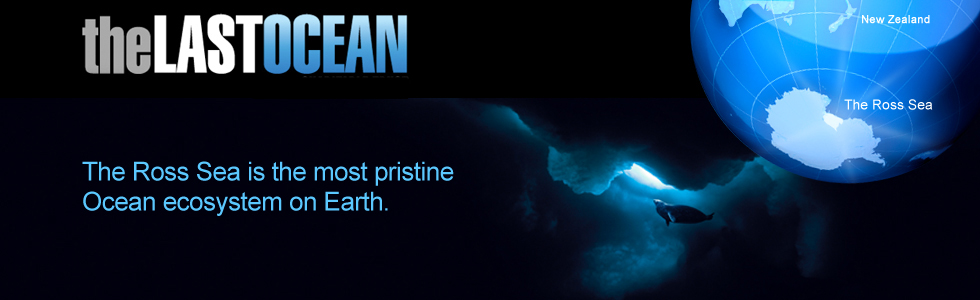
Overwhelming evidence suggests that over-fishing has profoundly damaged most, if not all the rest of the world’s marine ecosystems. Estimates are that we’ve eaten 90% of the world’s top predatory fish, finned 95% of the world’s sharks, and harpooned 90% of the great whales. The oceans are in serious trouble. The Ross Sea is recognized as the most pristine open-ocean ecosystem left on earth. In essence, the Ross Sea is the last ocean.

Antarctic Toothfish

Photo: Glenn Jacobson
© 2008 Australian Antarctic Division
Kingston Tasmania 7050

The Threat

is industrial fishing, started in 1996 by New Zealand and now including a dozen nations, targeting a key predatory fish in the Ross Sea – the Antarctic toothfish, which is sold as Chilean sea bass. The industry maintains that the fishing pressure has not yet caused irreparable harm to the ecosystem. However, recent reports indicate that in just 12 years, the fishing already has had a dramatic impact in the southern Ross Sea. The Ross Sea ecosystem, the last healthy open-ocean ecosystem left on earth, is in immanent danger.

If fishing continues in the Ross Sea, the dynamic balance will fall apart like a house of cards, and our last chance to understand the complexity of a healthy marine ecosystem will disappear, forever.

What We Can Do

The Ross Sea has not gone unnoticed in the ocean conservation community. Both the 2003 World Parks Congress and the 2008 World Conservation Congress have enunciated the need to designate all or most of the Ross Sea as a marine protected area, an idea echoed in recent initiatives by the World Conservation Union (formerly IUCN) and ASOC (The Antarctic & Southern Ocean Coalition). These organizations are an important component of an overall solution in the Ross Sea, but they are not yet enough.

To create the change needed to protect this place, the public must weigh in. WE ALL must weigh in. The Ross Sea story is not just about science, not just about the incredible organisms that live at the edge of the world. It is a story of interconnected communities. It is our story. It is the story of our struggle to become sustainable. And if enough of us speak up we may be able to write the next chapter.

We have created The Last Ocean Project as a center to collect this community. Please learn more, and join us in the effort to protect the Ross Sea.